
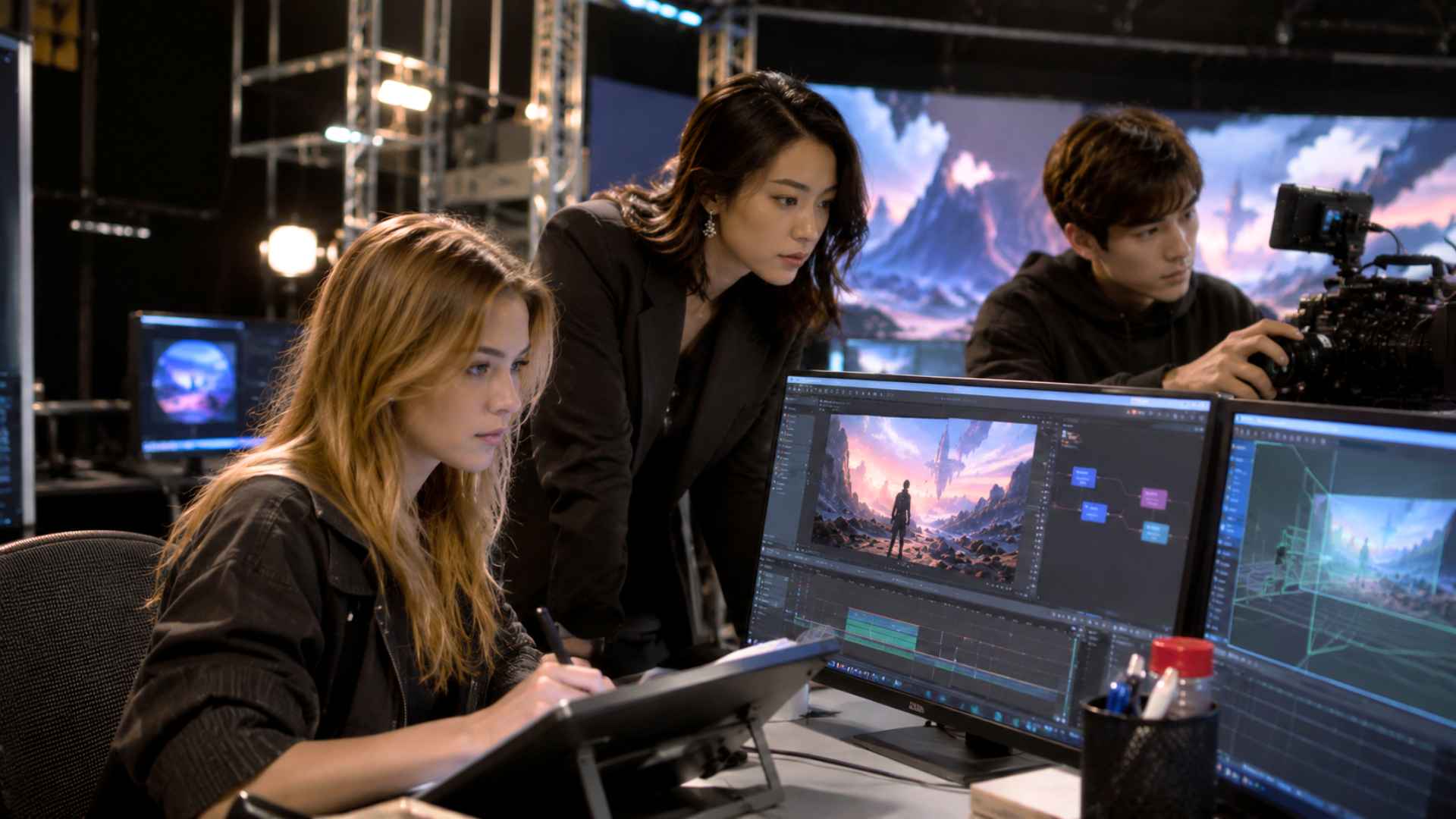
Creative media production now combines familiar tools such as cameras, editing software, and animation systems with machine learning, real time graphics, and spatial computing. These technologies affect more than the appearance of finished work. They change how teams prepare scenes, test visual ideas, manage assets, and deliver content across screens and interactive environments. Their roles differ, however. Generative models create candidate material from prompts or references, real time engines calculate scenes as users or cameras move, and immersive systems respond to a viewer’s position. Each approach has distinct technical requirements and practical limits.
Digital formats provide useful context for these changes. Standard 1920 × 1080 video contains 2,073,600 pixels per frame, while 3840 × 2160 video contains 8,294,400, exactly four times as many. At 30 frames per second, a one minute sequence contains 1,800 frames. Higher resolution and frame rates increase the amount of image information that production systems must process, store, or compress. New media tools therefore need to be judged not just by visual quality but also by processing demands, consistency, editing control, and the needs of the intended audience.
Generative AI in Image and Video Workflows
Generative AI can produce images, short video sequences, speech, and other media elements from text or existing material. Image generators commonly use diffusion based techniques, which learn visual patterns from training data and produce new outputs through a sequence of computational steps. Video generation adds the challenge of consistency across time: characters, objects, lighting, and camera motion need to remain coherent from frame to frame. This makes a convincing individual image different from a reliable, editable video scene. Generated footage can support concept tests and storyboards, but its suitability for final production depends on the specific output.
Practical use requires deliberate review. Generated material may contain distorted hands, inconsistent object details, inaccurate written text, or movements that fail to follow physical expectations. Editors may need to correct these problems with conventional compositing, retouching, or replacement footage. Rights are another consideration because model providers, source materials, and intended uses can be governed by different terms. A production team should document which assets came from recordings, licensed libraries, or generative tools. That record helps staff assess permissions and prevents synthetic material from being presented as documentary evidence when it is not.
Real Time Graphics and Virtual Production Sets
Real time 3D engines calculate images quickly enough to support interaction and immediate visual feedback. In virtual production, camera tracking can connect a physical camera’s position to a computer generated scene. Large LED walls may display that scene behind performers, while the image perspective changes with camera movement. The approach can provide practical reflections and environmental light on the set, reducing some work otherwise required with green screen compositing. It does not eliminate post production: color matching, camera calibration, synchronization, and visual corrections can still be necessary. Production design and technical planning remain central to results.
Performance creates a clear engineering constraint. At 24 frames per second, a system has roughly 41.7 milliseconds to prepare each frame; at 60 frames per second, the interval falls to about 16.7 milliseconds. This budget must accommodate scene calculations and other tasks required by the display pipeline. Detailed geometry, complex lighting, and high resolution textures can reduce performance, so artists often adjust scene complexity or use precomputed assets. Real time methods are also useful outside film sets, including broadcast graphics, architectural visualization, and interactive exhibitions where audiences expect an immediate response to movement or input.
Immersive Media, Spatial Sound, and Content Authenticity
Virtual reality and augmented reality create additional ways to present stories and information. Virtual reality generally places viewers inside a computer generated environment, whereas augmented reality combines digital elements with a view of the physical world. Headsets with six degrees of freedom can track three forms of rotation and three forms of translation, allowing the scene to respond when a viewer turns or changes position. Unlike fixed frame video, this format requires creators to consider what appears beside or behind the viewer. Clear visual cues, legible interface elements, and comfortable motion are therefore part of the creative design.
Spatial audio supports these environments by placing sound sources within a three dimensional scene rather than treating every sound as a fixed stereo signal. When head tracking is available, software can update the apparent direction of sounds as the listener moves. Meanwhile, photogrammetry can reconstruct three dimensional surfaces from overlapping photographs, supplying digital replicas of objects or locations for interactive experiences. These methods are not interchangeable: sound placement affects orientation and atmosphere, while reconstructed geometry affects visual space. Both also require checks for accuracy, accessibility, hardware support, and file size before a project reaches its audience.
Media authenticity has become equally relevant as synthetic content becomes easier to produce. The C2PA technical standard defines a way to attach cryptographically signed information about an asset’s origin and editing history. Such credentials can help recipients inspect recorded production details, but they do not prove that every depicted event is true, and metadata may be stripped during distribution. Responsible creative workflows combine provenance records with editorial checks, asset permissions, and clear disclosure where needed. The most useful technologies are those that solve a specific production problem while preserving reliability, human judgment, and audience trust.