
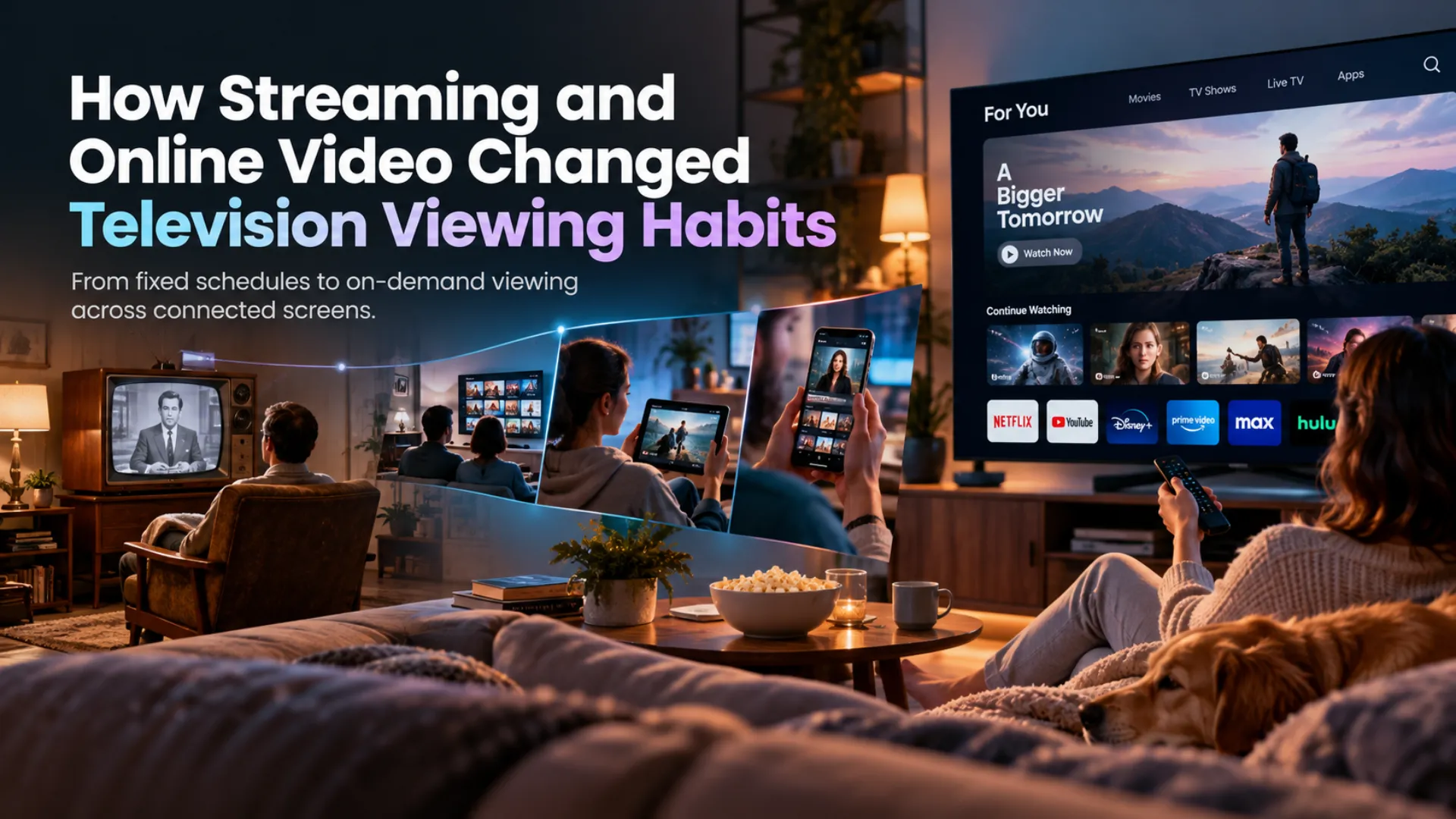
Television has undergone several major transformations since it became a widely used form of household entertainment during the twentieth century. For decades, broadcasters determined when programmes were transmitted, and audiences organized their viewing around established schedules. The introduction of home video recording provided greater flexibility, but scheduled broadcasting continued to shape television consumption for many years.
The expansion of broadband internet and online video services gradually introduced new ways of accessing programmes, films, and other audiovisual material. Viewers gained more opportunities to choose what they wanted to watch and when they wanted to watch it. These developments changed the relationship between television content, distribution technology, and everyday viewing habits.
The transition from scheduled broadcasts to a more varied media environment has not followed a single pattern in every country or demographic group. Traditional television remains important for news, sports, major public events, and other forms of programming that benefit from simultaneous viewing. At the same time, streaming services and video-sharing platforms have expanded the range of content available through connected televisions, computers, tablets, and smartphones.
Research into media consumption demonstrates that these different methods of viewing often coexist rather than simply replacing one another. Age, household circumstances, internet access, programme preferences, and national media systems can all influence viewing choices. Understanding contemporary television therefore requires examining both technological change and the social habits that determine how people use available media.
The Shift From Broadcast Schedules to Viewer Choice
Traditional television developed around a broadcasting model in which programmes were transmitted at specific times through a limited number of available channels. This structure influenced daily routines because viewers often needed to be present during a scheduled broadcast to watch a particular programme. Recording technologies gradually reduced this restriction by allowing programmes to be saved for later viewing.
Digital video recorders subsequently made recording and time-shifting more convenient, while electronic programme guides simplified the selection of scheduled content. Internet-based video services extended these possibilities by making many programmes accessible without requiring a conventional broadcast schedule. As a result, the timing of television consumption became increasingly flexible for viewers with access to these technologies.
On-demand viewing also affected how audiences experience serialized programmes and longer narratives. Instead of waiting for weekly broadcasts, viewers may be able to watch several episodes of a series in a single session when the relevant episodes are available. This practice is commonly described as binge-watching, although researchers and audiences do not always define the number of episodes involved in the same way. Extended viewing sessions can influence how audiences remember events, follow narrative developments, and discuss programmes with others. However, the availability of entire seasons does not mean that all viewers prefer to watch them continuously. Many people continue to divide their viewing across several days or follow scheduled releases according to their available time and personal preferences.
Why the Television Set Still Matters
The growth of smartphones, tablets, and computers has increased the number of devices capable of displaying audiovisual content. Nevertheless, television sets remain important in many households because they provide large screens, shared viewing opportunities, and convenient access to multiple entertainment services. Modern connected televisions can display traditional broadcast channels alongside streaming applications and internet-delivered video.
External streaming devices and set-top boxes can provide similar functions on compatible screens. These developments have changed the technical capabilities of the television set without eliminating its familiar role in domestic entertainment. The television is increasingly a display for content distributed through several different systems rather than a device limited to conventional broadcasting.
Research from the United Kingdom illustrates this continued importance of television screens. According to Ofcom’s Media Nations 2025 report, 84% of in-home video viewing in 2024 took place through television sets. This measurement covered video viewing within the home and should not be interpreted as representing all viewing across every location or country.
The same research documented a long-term decline in traditional broadcast television viewing alongside the continued use of television screens for audiovisual entertainment. These findings demonstrate why the distinction between a television device and traditional broadcast television is increasingly important. A household may spend substantial time watching a television screen while obtaining much of its content through internet-based services.
Online Video and the Changing Living Room
Online video platforms have expanded the kinds of audiovisual material that audiences can access from home. Alongside professionally produced films and television programmes, viewers can encounter educational videos, recorded interviews, documentaries, independent productions, and content created by individuals. These materials differ substantially in production quality, purpose, duration, and editorial standards. Their availability has broadened the range of subjects and presentation styles accessible through everyday viewing devices. Recommendation systems and search functions also influence how people discover material, although viewers retain varying degrees of control over their selections. The resulting media environment combines traditional audiovisual conventions with forms of content that developed primarily through internet distribution.
The increasing use of video-sharing platforms on television screens demonstrates how online and traditional viewing environments can overlap. Ofcom’s 2026 research reported that average daily YouTube viewing on television sets in the United Kingdom increased from nine minutes per person in 2022 to nineteen minutes in 2025. The measurement concerns viewing through television sets and does not represent the total amount of YouTube use across all devices. It nevertheless provides evidence of a significant change in how a familiar household screen is being used. Content associated with computers and mobile devices is now also consumed through equipment traditionally associated with broadcast television. This development makes the viewing location and the content distribution method separate questions in the study of audience behaviour.
Audience Discussion Beyond the Broadcast
Watching television has long included a social dimension, whether through conversations among family members, discussions with friends, or shared reactions to major events. Digital communication has expanded the settings in which these conversations take place. Discussion forums, social platforms, and online communities allow viewers to exchange opinions with people outside their immediate social circles.
These discussions may focus on plot developments, performances, production decisions, historical accuracy, or competing interpretations of fictional events. Some conversations occur while a programme is being broadcast, while others develop after viewers have watched it at different times. The availability of digital discussion spaces has therefore created additional forms of social participation around television content.
Serialized dramas with complex fictional worlds have provided particularly visible examples of audience interpretation and discussion. The American television series Lost, which aired between 2004 and 2010, became associated with extensive online debates about its mysteries, characters, and narrative clues. Viewers used digital communities to compare observations and propose explanations for events presented across different episodes.
These activities illustrate how the experience of television can extend beyond the period spent watching an individual programme. Audience discussion is not necessarily part of an officially planned narrative, and interpretations developed by fans should be distinguished from material established by a programme’s creators. Nevertheless, such discussions form an important part of the cultural history of television and its relationship with digital communication.
What Audience Research Reveals About Media Consumption
Audience measurement provides useful evidence about changes in viewing habits, but the meaning of individual statistics depends on how the research was conducted. Television ratings, household surveys, platform usage figures, and time-use studies measure different aspects of media behaviour. A figure describing the number of people who access a service does not necessarily reveal how frequently they use it or how much time they spend watching. Similarly, the popularity of a streaming application does not automatically indicate the disappearance of traditional broadcasting. Differences in age groups, geography, measurement periods, and device categories can produce substantially different results. Researchers and readers therefore need to examine the context of audience statistics before drawing broad conclusions about changing media habits.
Ofcom’s 2026 Media Nations findings offer an example of why careful interpretation matters. Among viewers surveyed in the United Kingdom, 26% identified Netflix as the service they usually turned to first when looking for something to watch, compared with 25% who selected the BBC.
Ofcom noted that the difference between those two figures was not statistically significant, meaning the results did not establish a meaningful lead for either service. The figures describe an expressed first choice rather than the total viewing time devoted to each provider. They also reflect a particular national market rather than a universal pattern of television consumption. The broader lesson is that media change should be examined through multiple indicators, because audience preferences, actual viewing behaviour, and technological adoption do not always develop at the same pace.